









2027 Salary Trends: what Australian and New Zealand employers are planning
Two-thirds of professionals in Australia and New Zealand received a pay rise this year. Fewer than four in 10 believe they are paid what they’re worth.
That gap shapes the 2027 pay review season. Interest rates are higher, unemployment has risen and inflation remains above target in both markets, yet almost every employer is still budgeting for an increase. Our 2027 Salary Guide, based on a survey of almost 2,000 employers and professionals and salary data from more than 100,000 advertised roles, shows where 2027 salary budgets and expectations meet, and where they fall apart.
What employers are planning for 2027 pay reviews
Australian employers have largely settled on a single band for pay increases. 67.4% plan to give increases of 2.5-5% in 2027, and a further 20.6% plan rises of up to 2.5%.
On the other hand, New Zealand employers are almost evenly split between increases of up to 2.5% (45.9%) and 2.5-5% (42.6%). Very few employers in either market plan to hold pay flat.
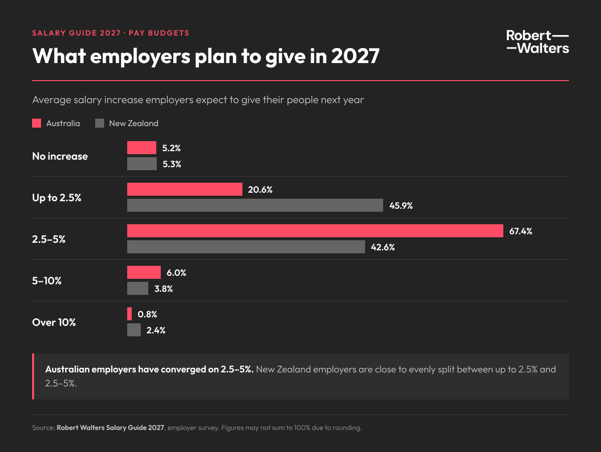
With unemployment at 5.7%, the highest in more than a decade, New Zealand employers are working with an uncertain market. This is what makes role-level benchmarking matter more this year, as it shows where pay pressure is actually building.
Who is most likely to receive a rise
Seniority makes a clear difference to who is likely to receive a pay rise. This likelihood peaks at Mid-Senior level, where 79.3% of Australian and 76.6% of New Zealand employers plan an increase, but falls away at both ends of the scale:
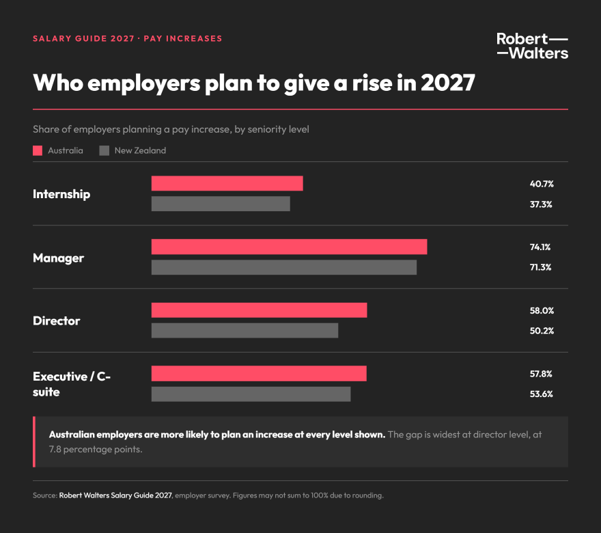
Pay rise likelihood is highest at Mid-Senior level and lowest at leadership level. At Director level, the likelihood of a pay rise has dropped from 72% to 58% in Australia since 2026, and from 58% to 50.2% in New Zealand.
What professionals expect
Employee expectations sit close to employer intent. 66.6% of Australian and 60.0% of New Zealand professionals expect a pay rise in the next year, up from 65% and 56% in 2026.
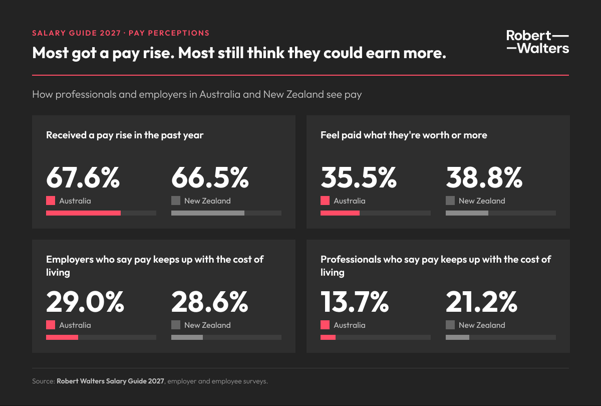
Most have also received one recently, with 67.6% of Australian and 66.5% of New Zealand professionals having received a pay rise in the past year. The New Zealand figure in particular has climbed from 57% in 2026, which is a notable shift given the weaker conditions in the job market.
The real gap is in how fairly paid employees feel. Only 35.5% of Australian and 38.8% of New Zealand professionals believe they are paid what they are worth or more, and the largest group in both markets believe they could earn slightly more. Better salary or benefits elsewhere is the most common reason for looking to move, cited by 32.3% of Australians and 26.9% of New Zealanders planning a change.
The cost-of-living gap
Fewer employers now believe pay is keeping up with the cost of living. In 2026, 40% of employers in both countries said salaries had kept pace. This year, that has fallen to 29.0% in Australia and 28.6% in New Zealand.
Most employers know the risk is real, with 69.5% in Australia and 68.6% in New Zealand expecting the cost of living to make retention harder in 2027. A rise of up to 2.5% sits below current inflation in both markets.
Bonuses are tightening
Fewer professionals are counting on a bonus this year, with 41.6% of Australians expecting one in the next year, down from 45% in 2026, and 22.8% of New Zealanders, down from 26%.
Australia runs ahead of New Zealand at every level of seniority. The widest gap is at Mid-Senior level, where 48.3% of Australian employers say a bonus is likely against 26.5% in New Zealand. For organisations hiring in both countries, it's worth considering that an Australian package often carries this variable component a New Zealand offer may not, making it more likely for candidates to compare total earnings rather than base salary alone.
Where pay is moving fastest
Median salary movement varies widely by specialisation. Here is a closer look at where it has shifted this year:
- Legal: 4.1% in Australia, the highest of any Australian sector, and 3.5% in New Zealand
- Procurement, Supply Chain & Logistics: 3.8% in Australia, where every role increased, and 2.5% in New Zealand
- Technology: 3.7% in Australia and 3.2% in New Zealand, with data and AI roles well ahead
- HR: 3.7% in Australia and 2.7% in New Zealand
- Accounting & Finance: 3.3% in Australia and 2.9% in New Zealand
Within each specialisation, some roles are moving much faster than the median, such as AI Engineers in Auckland now earning around $160k, up 14% on last year. The full guide breaks pay down role by role, across every Australian state and the major New Zealand cities.
6 steps to take before your 2027 pay review
- Benchmark the roles you can least afford to lose. Start with mid-to-senior professionals and roles in high demand, as a rise that fits the budget may still leave them below market.
- Set the budget, then allocate by role. Most Australian employers are working within 2.5% to 5%. In New Zealand, where views are split, decide early which roles justify the upper end.
- Explain how the number was set. With only 13.7% of Australian professionals believing their pay keeps up with living costs, openness about how increases are decided makes a disappointing rise easier to accept
- Look at total reward alongside base pay. Flexible working is a top three benefit for 85.5% of professionals and additional annual leave for 44.7%, which can make a review feel more substantial when budgets are tight.
- Address bonus changes early. If variable pay is being reduced, say so before review season rather than at payout, when it is most likely to prompt a resignation.
- Compare new-hire offers with internal pay. New-hire salaries often move faster than internal increases, so check offers against the guide to avoid new starters overtaking long-serving staff.
Final thoughts
The 2027 pay picture is slowly coming into focus. Australian employers have found a clear consensus, New Zealand employers are still weighing up where the market lands, and professionals in both countries are watching how far their pay stretches.
The organisations best placed to hold onto their people next year will be the ones directing their budgets to the roles that matter most, looking beyond base salary, and remaining open with staff about how pay decisions are made.
FAQs
-
What is the average salary increase for 2027 in Australia?
Most Australian employers are planning pay increases of between 2.5% and 5% in 2027. According to our 2027 Salary Guide, 67.4% fall into that range, and a further 20.6% plan rises of up to 2.5%. -
What pay rise are New Zealand employers planning for 2027?
New Zealand employers are split on 2027 pay. Our 2027 Salary Guide shows 45.9% of employers are planning increases of up to 2.5%, 42.6% are planning 2.5% to 5%, while just 5.3% plan no increase. -
Are bonuses still common in 2027?
Fewer professionals expect a bonus in 2027. Our Salary Guide shows 41.6% of Australian and 22.8% of New Zealand professionals expect one in the next year, down from 45% and 26% respectively in 2026. -
Want role-by-role salary data for your team?
Download the Robert Walters 2027 Salary Guide for salaries and further insights across 11 specialisations in Australia and New Zealand, or speak to one of our consultants about benchmarking your roles against the market.
Related content
View All
Robert Walters has been recognised as a Major Contender and Star Performer in both Everest Group's 2026 Contingent Workforce Management (CWM)/Managed Service Provider (MSP) and Services Procurement/Statement of Work (SOW) PEAK Matrix® Assessments. This dual recognition highlights the strength of our
Read More
It’s the end of the year, headcount has been approved, and the suggestion has been made to defer the search for the new hire until the new year. The holiday season is approaching calendars are filling quickly, and January appears to offer a cleaner starting point. But what looks like a short pause t
Read More
Nearshore vs offshore outsourcing For organisations considering an outsourcing move, the choice between nearshore and offshore will shape how they hire, where they build capability, and what their workforce looks like over the next decade. Both models extend access to talent beyond the home market.
Read More